
I went to the National Museum, Cardiff, a couple of weeks ago, to see their exhibition of Japanese design, Kizuna.

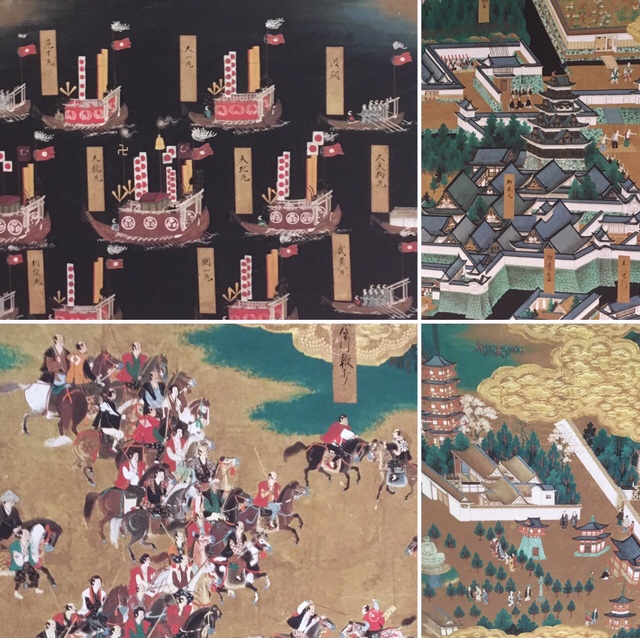
There’s a lot of good stuff on display, but for me the highlight was this, a 12 panel screen that formed a map of Edo (Tokyo):

It’s massive and yet full of detail, each place labelled, each home to one or more small scenes playing out, focusing more on the samurai city rather than the merchants.
There are lots of other things – pots, kimono, woodblock prints, a Honda car, scrolls, and so on, old things and new, pieces of high art and mass produced commercial objects. This is motivated by 2 claims – firstly that there is a strong thread of continuity in Japan’s artisanal culture stretching across centuries (hence showing old objects and new ones), and second that this is visible not only in fine art, but also in everyday life (hence including tape recorders alongside the scrolls and screens).
These ideas aren’t particularly unusual for anyone used to Japan and exhibitions of Japanese art and culture. In the UK, the paradigm example of the fascination with Japanese design was the 1991 Visions Of Japan exhibition at the Victoria & Albert Museum, which produced a boxed catalogue including a beer bottle label, a bus ticket, and a piece of the green plastic that separates different parts of a box of sushi: this is very much an exhibition in the same vein.
But the two claims of Japanese design’s importance across time and society are not beyond scrutiny: I imagine that my anthropology teacher Roger Goodman would stress that they are normative statements as much as statements of fact. So whilst it is possible to chart a history of Japanese artisans over time – pointing to the Nishijin weaving district of Kyoto, for example – the past offers an array of different examples and hence a range of possible narratives. It’s not clear, for example, that the Tokugawa class system, which placed artisans above only merchants and beneath even the peasants in status, obviously placed a high value on design and making. Likewise, modern Japan is full of aesthetically pleasing sights and material culture which definitely strike tourists, but the average Japanese street is also full of jumbled telephone wires and power cables and people like Alex Kerr have written about the concreting of the Japanese countryside and the commodification of sacred sites.
That said, they are ideas with a long pedigree in the West. The nineteenth century travellers who visited Japan from Europe and America were struck by Japanese art and objects, and accumulated great collections of ‘curios’ and ‘bric-a-brac’ – from giant temple statuary to straw sanders and raincoats – which they often assembled into Japan rooms back home. The high aesthetic value that these travelers found in Japan and Japanese life was in part an antidote to the encroaching modernity at home and a sense of ennui it engendered. Japanese art was sometimes compared to that of the ancient Greeks, for example, immediate and untainted by self-knowing and self-consciousness – an innately orientalist frame, but an approving one.
The idea of an artisan Japan has weight in Japan, too. People will often connect the great electronics firms and the Japanese tradition in engineering to a longer history of making. Amongst the National Treasures of Japan, alongside ancient sculpture and paintings, temples and shrines, there is a category of ‘important intangible cultural property’. These are a list of artists and makers – of lacquer and pottery , as well as others such as actors in the traditional theatres. Commonly known as ‘living national treasures’, strictly it is the techniques that these people practice, that they embody, which are the treasures, rather than the people themselves, but it is something that I don’t think has a parallel in the UK.
There is a knot at the heart of the question of Japanese design, material culture, and Japanese aesthetics then. It is easy to trace the ways in which this foreign image of Japan was constructed, disseminated, and even freed from the referent of an actually existing Japan. In many respects it’s perhaps better to think of these ideas as constructed ways of thinking about Japan and Japanese culture, or ways of seeing Japan, rather than objective truth. But at the same time, it is also an image rooted in the experiences of travelers’ encounters with Japan, and indeed it still reflects something of the experience of travelers to Japan today, I think, even something that weighs upon Japanese ideas of their own society, too. Consequently, the idea of the importance of design and aesthetics in Japanese society is one which we have to recognise as grounded in experience and carrying weight and power at the same time as treating it as a construct, balancing credulity and skepticism.
 Fireflies