My father died three weeks ago. He’d been sick for a while, and it was a peaceful end, but still.
Dad loved, really loved, boardgames. According to one list, which I’m pretty sure isn’t fully comprehensive, he had 1072 games. That’s enough games to play one per week for 21 years. What had been my bedroom became the warehouse for this ever expanding collection, games piled up head high in stacks in the middle of the floor once the shelves were full. It crept out of the room, onto the landing.

My sister’s and my childhoods were full of boardgames – we played them on holiday, at the weekend, with friends and relations, just as a family. We rapidly went beyond Monopoly and Cluedo to increasingly niche titles – he was into German boardgames at a time when translated rules were still hard to come by, for example.
After he died, we went back to my parents’ house and one of the first things we had to do was to tidy the games room so that one of us could sleep in it. Sorting through the boxes, I kept on coming up with games that I’d forgotten existed, but which evoked really strong memories.
1) Acquire

My earliest board game playing memory is playing Acquire. It’s not exactly kindergarten fare – on top of being reasonably complicated, the board is an entirely abstract grid of squares, the pieces are similar, and the theme is M&A in the world of high class hotels. I think the idea that I was playing an adult game was at least part of the appeal. It’s fairly popular – I’m pretty sure it’s been reissued in at least a couple of more alluring formats than this one, but we’ve been playing this copy in the family since the early eighties at least. Some time in the 90s, someone had to reread the rules for some reason and in doing so discovered that we’d been playing the game wrongly for well over a decade.
2) Rage
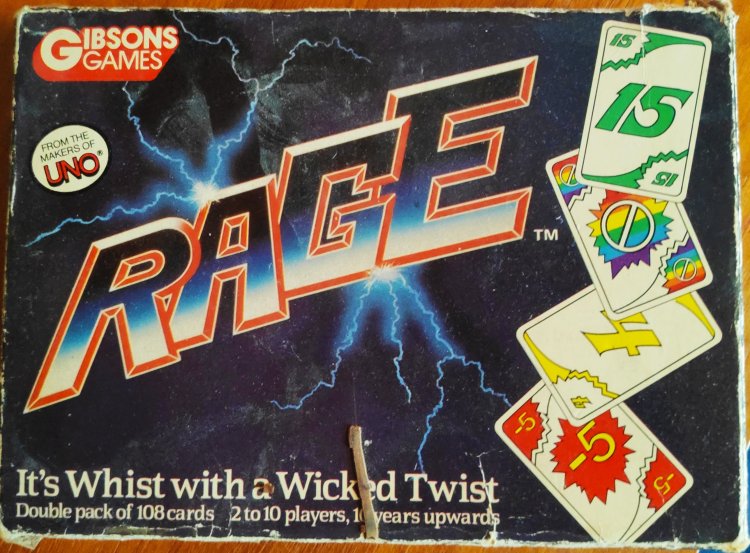
For many many years, we would have a summer holiday in Cornwall, packing the car up so full of clothes, pots, pans, beach kit, golf clubs to take down to a self-catering cottage, leaving at 5 am, breakfasting with Auntie Hilary in Exeter, sitting in traffic in Okehampton, looking out for the first sight of the sea. Obviously the games would take up a serious chunk of boot space, but there were a few small card games we used to play: as a family and with two or three other families who came down at the same time – Uno I guess is pretty well known, but Rage is another goodie. It’s like Whist, but you bid on how many tricks you expect to take and there are additional special cards to spice things up. You start with a round of 10 cards per person, but each subsequent deal you have one fewer card per hand, so by the time things get down to 4 or 5 cards per round, things get quite path dependent and unpredictable.
We might have 8 people sitting round the deck in an evening after a day on the beach. I can still remember one of the other dads’ cries of ‘you buffoon…’ as the deck took a turn away from him.
3) Midnight Party

At some point, Dad started getting into the German boardgame scene, and playing games with a wider range of people, but at home he still had to deal with playing partners who were preteens. Midnight Party isn’t a simulation of the historic growth of the railroads, it’s not a complex resource allocation game (I don’t really understand what they are), and there’s little in the way of strategy. But for a fairly long time it was one of the cast iron favourites in the family, one of a series of games that was played repeatedly over a span of probably a few years.
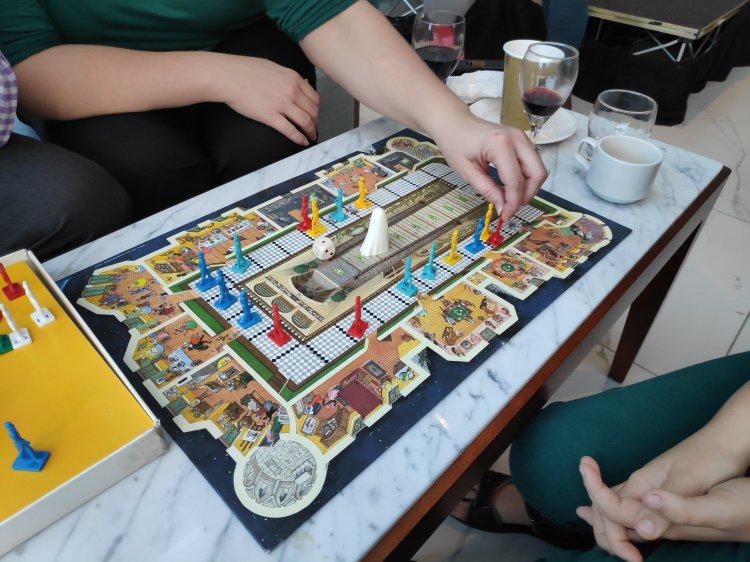
You’re in charge of a series of party guests at in a haunted house, and when Hugo the ghost comes out, you have to scramble for rooms lest he catch you. Because it features figures representing people moving round a board, it has situations when two or more game-people are occupying the same square. Dad loved pretending to be said people, and trying to strike up a conversation. “Oh, hello, what are you doing at this party”, that sort of thing. Me and my sister hated it. Really hated it.
It might not have been Dad’s ideal type of game but several years later, at some games convention in a hotel somewhere on the south coast, I think, he discovered (participated in the creation of?) a tradition of a midnight game of Midnight Party. And he won, at least once. So our childhood preferences rubbed off on him somewhere and somewhat.
4) Sorcerer’s Cave


The Sorcerer’s Cave box (and to a lesser extent that of its sister game The Mystic Wood) seems to be the most battered one in the whole collection. It’s another old favourite, played for years. It’s like the computer game Rogue or the Fighting Fantasy books turned into a boardgame – you start with a party of adventurers (the Man, Woman & Dwarf combo is the classic) and explore a series of tunnels and caves, seeing who can get out with the most treasure. To be honest, it’s a bit broken as a game, because if you start to do well, you rapidly become indestructible (although the ever present threat of a trap or an earthquake can still block your escape route) but the theme was one that really appealed as a boy. And now my son has started playing it, too, with the same reckless ‘descend as far as fast and as deep as possible’ strategy as I used to take. In returning to the game, perhaps since becoming a father, I have started to take a more measured approach, sticking to the first level for as long as seems prudent, and descending down to the more dangerous levels below only when ready. My son always seems to win.
4) Ultima V

Dad used to smuggle me into his office some weekends to play computer games while he caught up on work. He was always paranoid that the security guard wouldn’t let us into the car park, so he would get me to hide in the footwell and he always said ‘I’m just popping in to pick up some papers’. The point was, unthinkable as it seems, we didn’t have a computer in the house (except when he brought one home from work).
I played a bunch of different games – Sim City, Leisure Suit Larry, but the all time favourite was Ultima V. Some of these games remain pretty much my ideal for what a video game should look like and do (not so much Larry…). Ultima V in particular is I think still the favourite fantasy/role playing game I’ve ever played. It’s insanely hard (I only finished it using a walkthrough) – to be honest, it took a fair amount of reading of hints and tips before I even really understood what the objective was, but eventually I got to a point where I was sending my own hints into some of the magazines which published reviews & guides in the 80s.
The Boy and I have just finished the most recent Zelda, and it’s a phenomenal work of art – truly beautiful to look at and fun to play, but I think Ultima V’s storytelling and complexity of play stacks up pretty well even against something so recent.
I can also remember also the first time my dad brought a laptop home from work. It was like a suitcase – about a third was taken up with screen and keyboard, the rest I guess was battery. We were waiting for Mum to come back from somewhere (a trip with the local primary school?), at night, in the car, and it was mind blowing that I could continue to play a computer game (NFL Challenge) whilst we waited.
5) Chess.com
When dad got sick, the range of things he could do became a bit limited. He was quite frail and could be a little bit slow to process information. Sometimes it was a bit hard to know how best to involve him in activities and family life, especially as we live a long drive away. However, my bother-in-law noticed me noodling around on the chess.com app one day, and mentioned that he played games on it with a friend of his. I hadn’t realised it could used for things other than puzzles. So we started playing, slow games that go at a move every day or so.
After a while it struck me that it might be the sort of thing that worked really well for Dad. It took a little bit of coaching to get him up and running on the app, and he lost a couple of games on time, but Mum says that he got his old chess books out and started rereading opening theory.
Dad loved Go. He never taught me, but I took it up when I was first in Japan (something which amused nearly all Japanese people when they found out), and when I came home I played with him and his friends fairly regularly. Perhaps because of good coaching in Japan, I was better than him by the time that we started playing regularly, but chess was different. Even with his slower processing power in the last year he seemed to have the edge. I have discovered that I really enjoy slower games, because I have the space to mostly not make stupid mistakes, but he still fairly easily manoeuvred me into increasing tangles until my position was futile.
This weekend we held a commemorative event for him. It wasn’t a wake, we never really quite worked out what to call it, but over 100 people from his work, his games playing, his village, and so on, got together. We had some food, Mum gave a speech, and we played some boardgames. His grandsons managed to work their own way through the rules of a fairly complex boardgame unaided. I (think I) won the game of Midnight Party, and Isobel managed to not upend any of the boards mid-game.
 Fireflies
Really interesting to read about you, your dad, your new family, and games. Few people can have had a more appropriate memorial event.
LikeLiked by 1 person
I loved reading this Ian. You will know that our family is not a family for board games but reading this made me understand, fleetingly, and reminded me so strongly of your father.
LikeLiked by 1 person