I mentioned before Nelson, with its handball court and breed of sheep. Here is the court (not, I assume in its original form), from a month ago when I went to see the annual ewe sale:

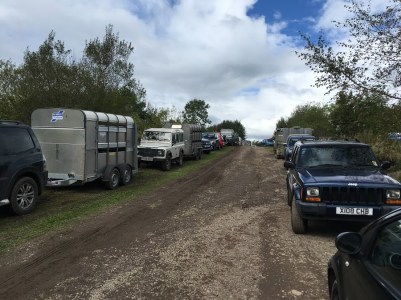
The sale took place in a field down a rutted track that was marked only by some temporary signs, and the largest collection of trailers and Land Rovers you’re likely to see.
It was on a much greater scale than I had imagined. There was a field full of pens, each one full of sheep, with people milling about. At the far side of the vast stretch of sheep there was a larger group of people clustered under a canvas roof. I walked around to it and found about 50 people gathered around a ring, with a wooden booth on one side, and chairs around the other three, one line of which had a flatbed pulled up behind to let more people get a good view.

Inside the pen a farmer, often with his dog, would steer his sheep, 5 or 6 at a time, around the ring, whilst the auctioneer in the booth called out prices over a tinny PA, and a woman sat next to him was recording the sales. The winning bidder would flash a card, but more often than not the auctioneer clearly knew the buyer by name. The crowd was a mix – mostly older farmers in check shirts, flat caps and baggy trousers, but a fair proportion of younger men in overalls and women in jodhpurs or barber jackets or the like. Whilst it was the older farmers who seemed to be driving the bulk of the bidding, most people seemed to be noting down the prices of each sale, which ranged from about £70 up into the £90s while I was there. The auctioneer would occasionally add a bit of detail: “a lovely bit of colour on these ewes”, or “straight off the mountain above tre-somewhere-or-other”, but otherwise there was little fuss and the lots ran one after another in quick succession.

Behind the scenes, it was a pretty impressive operation – the sort of thing that looked easy because it worked, but only because everyone knew what had to happen when and who (and what) went where. Each parcel of sheep would be brought out of their numbered pen and through a series of temporary pens down a channel leading them to the main ring. As I walked around to watch backstage, a farmer stood idly by, waiting to be next into the ring. He was calling ‘come by, come by’ to his dog which was paying no attention; it jumped through a gate into another collection of the farmer’s sheep, darting back and forth in front of them.
After each sale, the next set of ewes would be let into the ring, and the other 3 or so waiting batches would advance in turn through another gate, one step closer to the main ring, like barges through a lock. On the other side, when they’d been sold they’d be let out of the main ring into another corridor back through the pens, and they would run down it, jumping and hopping over one another, eventually put into the pen from whence they had started. This all worked smoothly, but looking at the number of pens and trailers, I couldn’t work out how on earth they would be loaded and taken away to their new homes at the end of the sale.

Then this weekend we went up to Penderyn, the other main site for sales of South Welsh Mountain sheep. This time it was a specialist ram sale – rather than pens of 5 or more ewes, a single ram at a time through two rings – one for Nelsons, and the other for White Faces and a range of other sheep – Blue Faced Leicesters and the ‘terminal sires’ that are used to breed a meat-heavy lamb.
There’s a permanent sale ring at Penderyn, but the system seemed a little more haphazard and the routes taken by the sheep less clear. Still, there was a big turn out – if anything more trailers and more Land Rovers, this time distributed all along the main through road. And the crowd is a real family affair – from children running about all the way up to old farmers who must be in their 70s at least. These oldest generation tend to be well turned out in jacket and cap, carrying a crook more often than not.
The rams are pretty big – either ours are runts or they’ve got a lot of growing to go. Every now and again one would decide it wanted to go back out of the ring and would take a run and leap at the gate, crashing into it with great force and a decent amount of lift. Again, they would be accompanied into the ring by their owner, standing to one side, hand in pocket, occasionally giving the ram a prompt with the crook to get it to turn and show itself off to all corners.
The more I think about it, the more remarkable the auction process is – picking the right ram is pivotal for the future of a flock, and the sale of ewes realises a good deal of time invested, but the prices paid rams varied wildly: I’m no judge of what they’re looking for, but the auctioneer, in shirtsleeves and tie, might drop his prices from £200* to £150 to below £100 for a ram, waiting for a first bid, but when started they could climb again and go up and up; one of the blue faced leicesters went north of £700. The range was anywhere from £120 or so up. The farmers have to be willing to make a decision on sight alone, as far as I can tell, and they have to decide whether to be willing to go from £150 to £1000 for a given ram, knowing all the while that their flock will be shaped by the purchases that they make. At Penderyn, the yard was fairly spacious, so once they’d won their lot, a farmer could walk back to the road, pick up their trailer and drive round to pay up, and head off, new purchase in tow.
* The prices are actually in guineas, £1.05
 Fireflies
Reblogged this on Zeelite.
LikeLike