World building
I watch Game Of Thrones – I’m not particularly proud of it, but it’s a bit of a guilty pleasure. I think that its great strength in the early stages was a willingness to violate time honoured rules of narrative in fantasy – most obviously to let anyone, anyone, die at any moment. But this seems to have faded in the latter stages, and what remains is a fairly conventional fantasy epic with a bit of an adolescent attitude towards sex. I think that what keeps me watching is not the nudity (honest) and not the narrative drive, but the world building – the glimpses of mythology and history behind the plot. The wall and its constructions, the people beyond it and the stories about the night walkers’ origins. Ditto the hints about the dragons of the past.
The same is true of another great unfinished fantasy series – the Kingkiller Chronicles. This has a fairly irritating central character (maybe that’s deliberate, but if so, why?) and much of the plot could be cut in my view (let us not speak of the sex fairy episode) but there’s a great historically/mythologically embedded mystery at the heart of it which shows flashes of a whole world and history behind the central story. We couldn’t have the world building without the core plot but I find myself getting frustrated as we wander off down another detour, waiting hundreds of pages for the next glimpse of the world behind the characters.
Supposedly these books were fully plotted out right from the outset (even written in draft?) – it almost has to be thus because there are so many interlinked themes about storytelling and mythology. In addition to a wandering story of an annoying main character, it’s some really interesting ideas about the relationship between the past and the present via story. The challenge in bringing them all together in a satisfying conclusion seems so steep the fear remains that this might remain eternally unfinished.
Coffee and Theory
I don’t think Physics is the only discipline which can be said to be a method of turning coffee into ideas – certainly I drink a lot of coffee and have the odd idea (generating a lot of waste paper as a byproduct). And perhaps as a result of this, I occasionally have ideas that are not just the product of coffee, their content is coffee, too. So I have a cappuccino model of analytic concepts, for example. For now here’s my rule of coffee and theory.
Simple put, it is that caffeine, irony, and capital-T Theory are all alike in that there is a right amount of them, not too little, but also not too much: a little bit of caffeine sharpens and clarifies, but too much leaves me a jittery mess; the right amount of irony is a great tool for self awareness, but David Foster Wallace is powerful on the alienation that results from too much (surely the thing that makes hipsters so annoying). And I think that one of the great issues in much contemporary work in the humanities seems to be that the cart often drives the horse when it comes to the use of theory to illuminate a subject.
I have what I think of as a very English skepticism regarding the use of theory – rather than spin up towers of interpretation built on the shaky foundations we work with as historians, I think it’s best to keep it simple – analyse and critique definitions, sure, but recognising all the while that our conclusions are preliminary and contingent, subject to change and refutation. So not too much theory, but also not none. The right amount.
Transitions
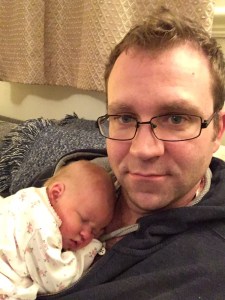
One concept that does illuminate life quite well is that of liminality – the precariousness that results from being outside of regular well established situations, or in transition from one stable state to another. We’ve been in such a position for the last week or two – back and forth between home and the hospital at all hours – watching the beech leaves fly up in the rear view mirror and the foxes slipping between the fence posts as we drive through the night – 9 months of waiting telescoped down to a few nervous days. It’s amazing to think that for midwives and doctors, our urgent moments are their Tuesday night shift, as my wife put it. We go through the maternity ward in an intense blur and come out the other end; they repeat it again and again. But whilst I wouldn’t say we’ve reached a stable state yet, we’ve definitely transitioned from a steady daily life into something very different.
 Fireflies
Reblogged this on Zeelite.
LikeLike